
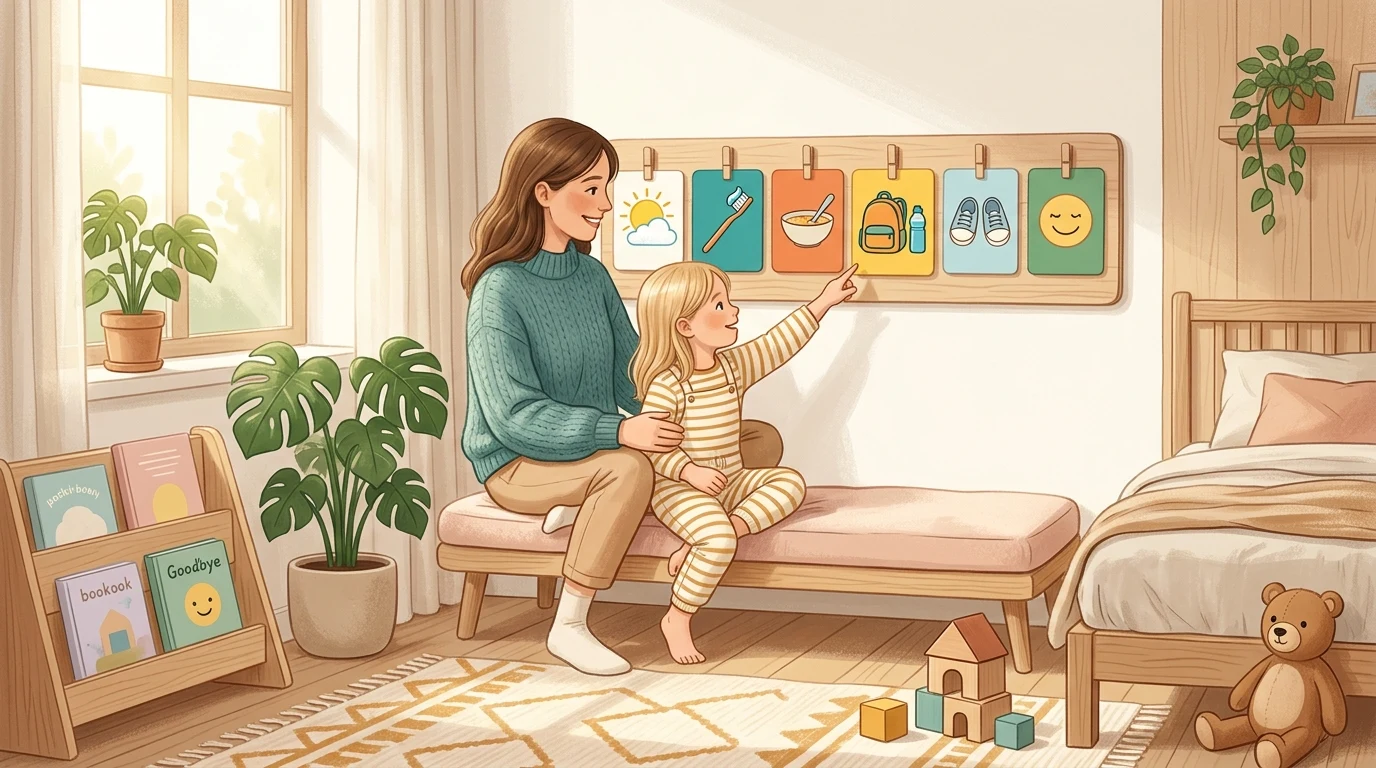
Some mornings seem to require twenty reminders before breakfast. A child needs to get dressed, brush their teeth, find their shoes, and remember their backpack. A parent needs to leave the house on time. If one step stalls, the entire morning can quickly spiral into frustration.
For children who struggle with organization, time awareness, or task transitions — including some children with ADHD — it helps to make routines visible, predictable, and small. The goal is not to turn childhood into a rigid checklist. It is to remove unnecessary confusion so a child knows exactly what comes next.
Why everyday routines can feel overwhelming
“Get ready for school” sounds like one instruction, but it hides a dozen separate actions. A child must remember the sequence, start each activity, shift attention between tasks, and recognize when they are finished. Those demands can be taxing when executive-function skills are still developing or when attention is difficult to regulate.
The Centers for Disease Control and Prevention (CDC) recommends practical behavioral strategies such as consistent routines, organized spaces, short clear instructions, dividing complicated tasks into manageable steps, and positive recognition for achievable goals. These strategies complement individualized guidance from caregivers, schools, and healthcare professionals.
Start with a routine your child can actually see
Instead of shouting across the house to “Hurry up and get ready,” try a visible, predictable sequence:
- Stretch and get out of bed.
- Brush teeth and wash face.
- Put on clothes (laid out the night before).
- Eat breakfast.
- Pack the school bag and put on shoes.
Each step should describe one concrete action. For younger children, “get dressed” may still be too broad; “put on your socks” is much easier to start. A colorful icon can communicate what to do before a child even reads the full sentence.
Make the next step more important than the entire list
A long list can trigger task paralysis. Showing one step at a time reduces immediate cognitive pressure: first brush teeth, then look at what’s next.
Try this simple rhythm: show one task, give one clear instruction, allow time, and acknowledge completion. When a child pauses halfway through, offer a small prompt such as “Let’s start by picking up the toothbrush” rather than restarting the entire list of demands.
Use visual timers gently
Some children find “two minutes” easier to understand when they can watch a gentle visual countdown ring. A visual timer makes time tangible and shows that a task has a clear beginning and end.
However, timers are tools, not tests of character. If a ticking clock causes anxiety, lengthen the duration, turn off sound effects, or remove the timer entirely. Sensory preferences and individual comfort always come first.
Celebrate effort without making every mistake a failure
Positive reinforcement is far more effective than a wall of red missed checkmarks. Notice effort aloud: “You remembered your bag all on your own!” or “You started brushing even though you were sleepy.” A star or achievement badge can make that recognition tangible, provided rewards are achievable and never tied to punishment or shame.
How parents can build an ADHD-friendly morning with My MOMENTUM
My MOMENTUM’s parent-guided Kids Mode was designed around visual routines, simple controls, and a protected Parent Area:
- Step 1: Create a child profile: Choose a nickname and a friendly avatar. No unnecessary personal details are collected.
- Step 2: Customize the Morning Routine: Include the activities that actually happen in your household. Keep steps fewer and simpler if needed.
- Step 3: Assign recognizable icons: Link a toothbrush to brushing, a bowl to breakfast, and a backpack to school prep.
- Step 4: Run the routine together: The child sees one clear task at a time and taps the big checkmark upon completion.
- Step 5: Review and adjust: If putting on clothes consistently takes longer, simplify the wardrobe choice rather than viewing the struggle as defiance.
- Step 6: Keep parental controls secure: A 4-digit Parent PIN keeps routine editing, configuration, and app settings protected from accidental taps.
Parent FAQs
Should I make every routine timed?
No. Use visual timers only when they are genuinely helpful and comfortable for your child. Timers should never create distress.
What if my child skips a step?
Ask whether the step was too broad, unclear, or poorly timed. Adapt the plan rather than penalizing the child.
Can visual routines help children without ADHD?
Yes. Predictable instructions and visual cues benefit many children developing independence.
Does an app replace professional behavioral therapy?
No. An app is an organizational aid. It does not replace evidence-based behavioral parent training or clinical care.